Composer


News
There is always something exciting happening in my musical world and anyone knows that I am usually at the center of it. Want to know what I have been up to? Check out all of my press coverage and news updates right here.

Composer Wins Classical Marimba League Award

August 31, 2007
The Classical Marimba League would like to inform that George Kontogiorgos was a 1st Prize Winner in the 2007 Classical Marimba League International Composition Competition with his work MINIATURES for Marimba and String Quartet.
George Kontogiorgos (Greece) is the 1st winner of the Classical composition style category.
Composer Wins Music for Garden Award

December 29, 2006
"Malwa" Contemporary Music Club in Kraków (ul. Dobrego Pasterza 6) announces the results of the 3rd International Competition Music for Garden, Kraków 2006.
George Kontogiorgos (Greece) wins the 3rd Prize for his composition SPRING IN THE SECRET GARDENS for Strings

Medal Awards


Composer Wins Silver Medal Award

January, 2022
TRIPLE SILVER MEDAL
OUTSTANDING ACHIEVEMENT by the Global Music Awards competition to composition, composer and Instrumentalist of the CD Album «ODES AND CANTOS»
released by IRIDA CLASSICAL
Composer Wins Gold Medal Award

September, 2023
DOUBLE GOLD MEDAL
OUTSTANDING ACHIEVEMENT by the Global Music Awards competition
for composer and composition of the CD Album «DE CHIRICO»
released by Phasma Music
Awarded CDs


SILVER MEDAL
SILVER MEDAL
TOP ALBUM OF THE YEAR 2020
November, 2019
November 21, 2019
December 2020
SELECTED AMONG THE BEST ALBUMS BY THE GLOBAL MUSIC AWARDS
OUTSTANDING ACHIEVEMENT
BY THE GLOBAL MUSIC AWARDS
OUTSTANDING ACHIEVEMENT
BY THE GLOBAL MUSIC AWARDS
SILVER MEDAL
January, 2022
OUTSTANDING ACHIEVEMENT
BY THE GLOBAL MUSIC AWARDS

DOUBLE GOLD MEDAL
September 2023
OUTSTANDING ACHIEVEMENT
BY THE GLOBAL MUSIC AWARDS

Reviews
Review for the CD DE PROFUNDIS, released by NAXOS, by John Hood
"STRING QUARTETS - A MOST INTIMATE MEDIUM
A Listener’s Guide to the Genre from 1800" March, 2017 issue
Greek composer George Kontogiorgos [born 1945] wrote three string quartets. To my ears, the chronology of these works reveal them to be less modern as they evolve. The first, titled Unicorn, is quite contemporary and very interesting. However I am going to discuss the Second and Third Quartets, and will endeavour to illustrate the above concept. Strangely enough, none of them made it into my primary reference work The Twentieth Century String Quartet – An Historical Introduction and Catalogue. Either the composer was overlooked or they were written after 2000, in which case, he started late.
The second string quartet, titled de Profundis, is in three movements. It features a moderate level of abstraction, which I particularly enjoyed. It starts with some lightly dissonant chords before a hint of a melody starts to emerge. The composer seems to be more concerned with rhythm at this point and there are some punctuating moments. The two violins, after a period of meandering, engage in an atonal conversation. The cello adds to the mix of sounds; it’s very busy. The violins continue with their atonal musings until the conclusion.
The second movement is very short, about two minutes. It opens with a two-note viola motif, and after each set of four bars, a new instrument appears to build the texture. A pulsating feeling dominates proceedings, which end with the two violins having a final engagement.
The last movement is based on a moderately dissonant three-note viola motif, which occurs in different guises throughout the movement. A brief, but slightly hectic violin exchange occurs around the motif as they accentuate with forceful phrases. A pause ensues and we hear the opening viola motif again. The violins first harmonise it, then develop the motif; one of the violins drops into pizzicato for a time. This is quite atonal. The viola motif is now distorted rhythmically and it gives way to the two violins, one in the high register, leading to a frantic passage which drifts back into an eerie soundscape. The distorted motif returns and the violins mock it as they swoop and fly. Now we are back to the original motif which is soon subject to fierce opposition. Every time the motif is repeated, it is changed by the ensemble, usually frantically. An explosive passage gives way to the motif one last time and a harmonised version concludes the piece. This is a fabulous piece of writing, very evocative!
The third quartet is titled Byzantine, which perhaps explains its nature. It contains four movements. The opening has a Baroque stateliness about it. The two violins carry poignant melodies while the cello provides a harmonic underpinning. They maintain a partnership for the duration of the movement; it sounds like music from another time. When it finished, I paused it and the atmosphere, almost ancient, seemed to linger for a while.
The next movement again starts with a gentle flowing melody. The violins respect the sparsity of the moment as they tread lightly through the cello harmony. There is some development, but the violins stay close to each other. The music meanders as notes join together to create a most gorgeous canvas of sound. This is delicate music, again, not of its age.
The third movement opens ever so quietly with an ascending scale using all four instruments. The phrase is continued a number of times until the violins move off into their own mood with spacious overlapping melodies. Now the opening phrase is repeated a number of times, at a quicker tempo. This time there are variations on the phrase. The intensity rises, but not for long as the violins continue their development.
The brief final movement is much brighter and for the first time in the quartet, we have energy. The violins and cello are very expressive, spinning out melodic lines, seemingly from long ago.
I don’t know what to make of this music. These two quartets could have been written by different composers in different eras. Make of it what you will. I find it to be magnificent.
The review CD is titled de Profundis, performed by The New Hellenic Quartet, but I can’t find these works anywhere, except as a download from Presto Classical. Being on Naxos I’m sure it could be located, probably even from Naxos. It is on Spotify – watch the spelling, and all of the quartets are on YouTube and earsense.
Listenability: A very diverse blend of fascinating, sometimes lyrical, music.
Critic of the CD ONE MINUTE by Iwona Glinka, flute including my composition CASTALIA SPRING
By Joe Cadagin, Fanfare magazine Issue 42:2 Nov/Dec,2017
"For George Kontogiorgos’s Castalia Spring, Glinka conjures a pastoral setting through breezy harmonics and bug-like tongue-clicks superimposed on a Hellenic-sounding melody"

DACING WITH CENTAURS New CD releases
of August 2019 by NAXOS

Review of CD album DACING WITH CENTAURS
by David Denton, David's Corner, August 2019

Review of CD album DACING WITH CENTAURS
in Records International, September 2019
Review of CD album DACING WITH CENTAURS
by David DeBoor Canfield,
in Fanfare Archive, February 12, 2020
Review of CD album DACING WITH CENTAURS
by Tina Kiik, in the Canadian Music Magazine
"The Whole Note", November 2020


NAXOS highlights of December 2020 CD releases,
including KALEIDOSCOPE
Review of CD album KALEIDOSCOPE
by David Denton, David's Corner, January 2021


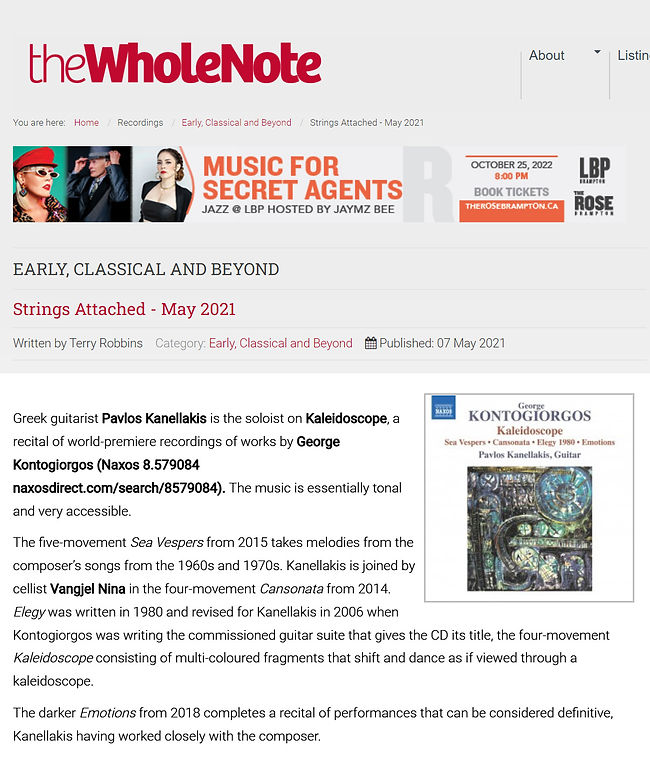
Presentation of CD album KALEIDOSCOPE
by Terry Robbins in the Canadian Music Magazine
"The Whole Note" No 26, pp. 56,57, May 2021
Review of CD album KALEIDOSCOPE
Presentation by James McCutcheon for the American Record Guide, May 2021

Review of CD album KALEIDOSCOPE
Presentation by James McCutcheon for the American Record Guide, May 2021

Presentation of my composition Ringtone
from the CD album DACING WITH CENTAURS
By Mauren Buja Interlude web magazine Dec 28,2020

Review of CD album KALEIDOSCOPE
Sea Vespers; Cansonata; Elegy: Kaleidoscope; Emotions
by James McCutcheon
" ......... This repertoire stands effectively on its own in relation to the rest of guitar literature. It is unique, and Kanellakis’ artistry and commitment to this project and to his instrument is undeniable ..... Cansonata for cello and guitar makes effective use of both instruments playing together juxtaposed with compelling solo sections. In the Adagio, my favorite track, cellist Vangel Nina interacts with the guitar with sensitive, perfectly intonated phrases. A unique compositional technique employs the guitar using tremolo as an accompanying texture, and this is later echoed by the cello using it to accompany the guitar. The final movement has the most contemporary language..........”
May/Jun 2021, Vol. 84 Issue 3, p63-63. 1/2 p.
STREAM / BUY the full album: https://Naxos.lnk.to/8579084FA
Review of CD album ODES AND CANTOS
by the IsraBox
Only a few days have passed since the release of the new personal discography of the beloved and important musician George Kontogiorgos (also known for his scientific capacity, that of pathologist with many distinctions). Although the composer in his first steps was involved with folk music (mainly with Neo Kyma (Zografos, Chomata) writing wonderful songs that are still sung, such as "Gypsy Day", in the last three decades he performed with zeal and passion, having a solid musical knowledge, in the composition of remarkable works of musical words that are distinguished for their intense lyricism. Some of them were recorded in his three previous personal recordings released by NAXOS, receiving rave reviews. The same positive response, from audiences and critics, I firmly believe that the new discography entitled "Odes and Cantos" will have. The guarantee is provided, in addition to the two wonderful works of the composer, by the participation of great performers, by the best in our country, such as the baritone Tassis Christogiannopoulos and the pianist Lorenta Ramou (they dreamily perform the vocal cycle of six songs entitled "The Affliction of Love” in poetry by an equal number of brilliant poets) but also the newly built Athenian String Quartet that accompanies our top baritone equally and equally excellently in the also vocal cycle “The beauty of a Greek” in poems by Lord Byron (in English). The low-key, simple writing of the composer, without extremes or unnecessary elements, with references to the romance of the 19th century, captivates you and gives you plenty of ecstatic moments. I believe that it will give equally unique moments of pleasure to those who become listeners-companions of this wonderful and sensitive music creation that adorns the IRIDA CLASSICAL catalog.
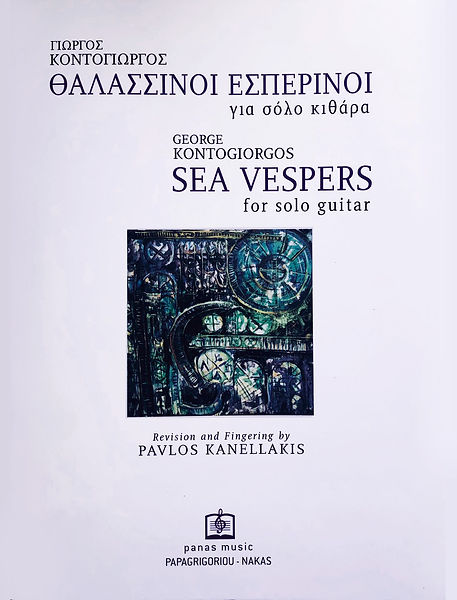
Score publication of the suite SEA VESPERS
by NAKASMUSIC Editions March 14,2023

Crescendo Magazine, Le 28 Décembre 2025 par Carlo Schreiber
Musique hellénique pour harpe et basson
George Kontogiorgos (1945): Tabula Rasa pour Harpe et Basson; Archaic Concerto pour Harpe et Cordes.
Rachel Talitman: harpe, Mavroudes Troullos: basson, Ensemble Harpeggio. 2025. Livret en anglais. 67'.
Harp & Co CD5054
Le nouvel album intitulé Musique hellénique pour harpe et basson du compositeur George Kontogiorgos est interprété par la harpiste israélienne Rachel Talitman et le bassoniste chypriote Mavroudes Troullos. Ces deux musiciens ont déjà étroitement collaboré par le passé, publiant trois albums consacrés à des œuvres de Luigi Concone, Anna Segal et Michel Lysight, établissant ainsi un partenariat artistique singulier, aujourd’hui reconnu internationalement.
George Kontogiorgos propose ici une réflexion personnelle sur l’héritage musical grec à travers une formation instrumentale aussi rare qu’expressive. Les deux interprètes mettent leur complicité artistique au service d’un projet qui dépasse la simple juxtaposition d’œuvres pour devenir une véritable construction dramaturgique.
Le choix de la harpe et du basson n’est pas anodin. Ces instruments, dont les filiations symboliques renvoient à la lyre et à la flûte de la Grèce antique, permettent au compositeur d’explorer un champ sonore situé entre archaïsme suggéré et écriture contemporaine. La harpe, tantôt percussive, tantôt lyrique, dialogue avec un basson aux registres graves profondément expressifs, créant un équilibre subtil entre transparence sonore et densité émotionnelle.
L’axe central de l’album repose sur la suite Tabula Rasa, cycle en dix mouvements qui illustre la pluralité stylistique de Kontogiorgos. Sans jamais tomber dans le pastiche, le compositeur y superpose références classiques, lignes lyriques, procédés minimalistes et épisodes atonaux. Cette hétérogénéité, loin de fragmenter le discours, est structurée par une cohérence formelle et une continuité expressive qui confèrent à l’œuvre une forte unité. Les interprètes y font preuve d’une maîtrise technique irréprochable, mais surtout d’une capacité à modeler le discours musical avec souplesse et intelligence. On pourra toutefois relever une certaine insistance sur les procédés répétitifs, qui, si elle participe à l’esthétique minimaliste de l’œuvre, peut parfois produire un effet de stagnation formelle à l’écoute prolongée. Il en résulte néanmoins une interprétation d’une grande cohérence artistique, où les deux instrumentistes parviennent à toucher notre sensibilité avec intensité et finesse.
Le Concerto archaïque pour harpe et cordes conclut l’album dans une atmosphère plus méditative. S’appuyant sur des hymnes anciens et des réminiscences mythologiques, l’œuvre assume une dimension presque rituelle, où le matériau musical semble suspendu hors du temps. Ce final agit comme une synthèse esthétique, donnant à l’ensemble de l’album une portée symbolique et narrative.
Rachel Talitman se révèle être une interprète profondément investie dans l’univers du compositeur, qu’elle semble porter de l’intérieur, comme si elle en était la voix. Elle est d’ailleurs à l’origine de la commande des œuvres à George Kontogiorgos, enregistrées pour son label Harp & Co, qui compte plus de cinquante publications depuis 2004. Le jeu de Mavroudes Troullos, par la richesse de son timbre et la précision de son phrasé, apporte une profondeur émotionnelle essentielle à l’équilibre de l’ensemble. Leur interprétation commune se distingue par une écoute mutuelle constante et une sensibilité partagée.
Au-delà de ses qualités instrumentales, cet enregistrement s’impose comme une proposition artistique cohérente et exigeante, qui invite l’auditeur à une écoute attentive et réfléchie. Un disque qui séduira autant par son originalité que par la rigueur de sa conception musicale.
De CD Hellenic Music for Harp and Bassoon presenteert een zorgvuldig opgebouwd muzikaal geheel waarin compositie en uitvoering onlosmakelijk met elkaar verbonden zijn. De werken van George Kontogiorgos vertrekken vanuit een duidelijke Helleense inspiratie, die zich manifesteert in modale structuren, ritmische patronen en een uitgesproken aandacht voor klankkleur, zonder te vervallen in letterlijke folkloristische citaten. De muziek beweegt zich tussen contemplatie en ritmische scherpte en vraagt om een grote mate van onderlinge afstemming tussen de uitvoerders.
In de stukken voor harp en fagot ontvouwt zich een gelijkwaardige dialoog. De harp introduceert vaak een transparant, soms bijna archaïsch klankveld, opgebouwd uit repetitieve figuren, open intervallen en subtiele harmonische verschuivingen. Daartegenover staat de fagot, die zowel een verhalende als een expressieve rol krijgt, met lange, zangerige lijnen afgewisseld door scherp geprofileerde ritmische motieven. De schrijfwijze suggereert een nauwe samenwerking tussen componist en uitvoerders, waarbij de technische en expressieve mogelijkheden van beide instrumenten tot in detail zijn verkend.
Rachel Talitman benadert de harp met een heldere articulatie en een fijn gevoel voor spanningsopbouw. Haar spel benadrukt de gelaagdheid van de muziek en maakt de structurele samenhang van de werken hoorbaar. Mavroudes Troullos geeft de fagot een opvallend flexibele en kleurrijke stem, waarin lyriek en ritmische precisie elkaar afwisselen. Zijn frasering sluit nauw aan bij de harp, waardoor de muziek een natuurlijke ademhaling behoudt, zelfs in passages met complexe ritmiek of dicht geschreven texturen.
In de werken met ensemble wordt het klankpalet verder verbreed. Het ensemble fungeert niet louter als begeleidend kader, maar draagt actief bij aan de vormontwikkeling en dramatische spanning. Strijkers en andere instrumentale lagen versterken de modale kleur en ritmische puls van de muziek, terwijl ze ruimte laten voor de solistische lijnen van harp en fagot. De balans tussen solisten en ensemble is zorgvuldig uitgewerkt, wat wijst op een collectieve interpretatieve visie.
Als geheel laat deze opname horen hoe hedendaagse muziek, geworteld in culturele traditie, kan uitgroeien tot een coherent en overtuigend artistiek project. De nauwe samenwerking tussen componist, solisten en ensemble resulteert in uitvoeringen die de structuur, kleur en expressieve intentie van de muziek helder tot hun recht laten komen. De cd biedt zo niet alleen een inkijk in de muzikale wereld van George Kontogiorgos, maar ook een voorbeeld van hoe gedeeld artistiek engagement de zeggingskracht van nieuwe muziek kan verdiepen.
Mavroudes Troullos & Rachel Talitman & Ensemble Harpeggio
George Kontogiorgos: Hellenic Music for Harp and Bassoon
Le Noise: written by Jérôme Gillet
froggy's delight #Semaine du 2 mars 2026
Mine de rien, Mavroudes Troullos se construit une discographie en marge des autres bassonistes.
Une discographie cohérente, interprétée avec la harpiste Rachel Talitman et un choix de répertoire éloigné des "grands classiques", si tant est que l’on puisse parler de grands classiques en ce qui concerne le basson: des créations mondiales de Luigi Concone, Anna Segal et Michel Lysight.
A ce répertoire s’ajoute maintenant le compositeur grecque George Kontogiorgos avec la pièce Tabula Rasa, suite en dix mouvements.
Peu connu en France, George Kontogiorgos s’est fait un nom en Grèce surtout dans les années 1960 et 1970, comme chef d’orchestre, arrangeur, principalement pour des maisons de disques, et comme compositeur pour la radio, le cinéma ou la télévision, et de nombreuses chansons populaires.
Le terme Tabula Rasa est peut-être un peu exagéré, il faudra le penser comme un papier vierge puisque c’est la première fois, suite à la demande de Rachel Talitman que Kontogiorgos composait pour harpe et basson. C’est une pièce en dix mouvements jouant sur les atmosphères, les techniques harmoniques tonales et atonales, les styles, les timbres (ce dialogue entre les deux instruments), inspirée de différents compositeurs (Debussy, Ligeti) qui sait mettre le registre du basson en valeur (on y sent Mavroudes Troullos totalement à l’aise).
Le Concerto archaïque pour harpe et cordes qui célèbre la mythologie grecque à travers des hymnes antique possède un certain charme. A découvrir donc.
South Shore Orchestra is committed to bridging musicians, audiences and communities to advance enjoyment and appreciation of orchestral music.
CELEBRATING 20 YEARS OF MAKING MUSIC!
2004 - 2024
George Kontogiorgos will be the featured Composer-in-Residence for South Shore Orchestra's
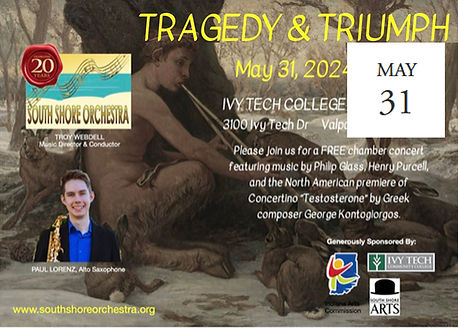
TRAGEDY & TRIUMPH
-
Friday, May 31, 2024
-
3:00 PM 4:00 PM
-
Ivy Tech College Auditorium Theater (map)
Join South Shore Orchestra for a FREE chamber concert celebrating our 20th Season Anniversary! Featuring Tragic and Triumphant music connected to Greek Mythology, Shakespearian Sonnets, and the Movies!
PROGRAM:
GLASS: Truman Sleeps from The Truman Show
KONTOGIORGOS: Concertino "Testosterone"
Paul Lorenz, Alto Sax / Patricia Lee, Piano
PURCELL: Suite from Abdelazar (Othello)
I. Overture, II. Rondeau, III. Air #1, IV. Air #2, V. Minuet, VI. Air #3, VII. Jig, III. Hornpipe, IX. Air #4
Tickets or reservations are not needed for this FREE event.
For more information visit southshoreorchestra.org
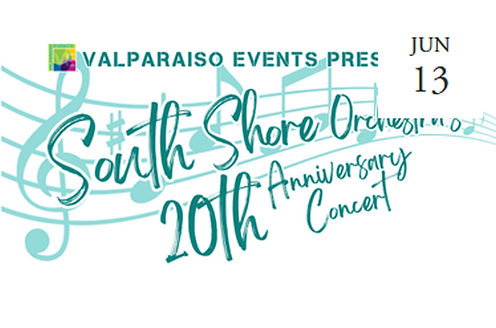
SSO 20th Anniversary Celebration Concert - FREE!
-
Thursday, June 13, 2024
-
7:00 PM 9:30 PM
Join Maestro Troy Webdell and South Shore Orchestra for a FREE concert celebrating our 20th Anniversary! Featuring orchestral music, food trucks, and a "champagne toast" to honor SSO's 20 years of making music throughout our community. Also featuring alto saxophone soloist Paul Lorenz and guest composer George Kontogiorgos, who will be coming from Athens, Greece for the North American premiere of his Concertino for Alto Saxophone and Orchestra.
PROGRAM:
MARQUEZ: Conga del fuego nuevo
KONTOGIORGOS: Concertino "Testosterone"
Paul Lorenz, alto saxophone / Patricia Lee, piano
*North American Premiere*
TCHAIKOVSKY: Symphony No. 5
I. Andante, II. Andante cantabile, Allegro non troppo, III. Valse, IV. Finale
STRAUSS: Radetzky March
This is a FREE concert and tickets are not needed. Bring your lawn chairs and help the SSO celebrate our 20th Anniversary!
https://www.valparaisoevents.com/event/south-shore-orchestra-20th-anniversary